|
A. Speck, E. Pulvermüller Wilhelm-Schickard-Institut für Informatik Universität Tübingen 72076 Tübingen, Germany {speck | pulvermu}@informatik.uni-tuebingen.de |
A. Rashid Department of Computer Science Lancaster University Lancaster LA1 4YR, UK marash@comp.lancs.ac.uk |
R. Chitchyan Computing for Commerce and Industry The Open University, UK OCNW, Storey Institute, Meeting House Lane Lancaster LA1 1TH, UK r.chitchyan@lancaster.ac.uk |
Introduction
The OO community has widely recognized that the object-oriented paradigm is not a universal solution in the field of software development. The reuse promise of object-oriented systems is hard to deliver in practice. Mechanisms such as inheritance and aggregation are limited to small pieces of software and do not scale up to large software products. The OO community has therefore taken the path of domain specific reuse. A promising approach in domain specific reuse is that of generative programming [CE99b]. Generative programming takes patterns from industrial manufacturing processes [CE99a]. A software development process is regarded as a special kind of industrial production where software is produced by automatically combining components via generators [BG97].
In this abstract we take a closer look at the term product line (which is crucial in generative programming), deduce that individual systems are also covered by this term and discuss how individual software production may be supported by generative programming (an area largely unexplored at present).
Product Lines
In [Bat98, Bat99] a product line architecture is defined as ``a design for families of related applications''. Other definitions can be found in marketing literature. According to [Kot97] a product line is a ``group of products that are closely related because they perform a similar function, are sold to the same customer groups, are marketed through the same channels, or fall within given price ranges''. Furthermore, according to [Kot97] a product line is a set of products and items that a particular seller offers for sale to buyers. From the above definitions two observations can be made:
Individual Software Development
The product line software generation according to [Bat98, CE99b] is clearly very useful for the development of families of systems (e.g. SAP system family or today's office systems). However it does not provide a universal solution. Systems developed according to the individual requirements of a customer e.g. industrial control software or banking software are not in the focus of this approach. Since most of these systems can be built using more or less the same set of components and is tailored to the needs of a customer their development can be supported by generative programming.
One approach for the development of these customer-specific systems is to build individual generation rules for each piece of software. However, this does not considerably reduce the cost of development. The complexity of the system's architecture shifts into the grammar describing the generation rules.
We observe that besides the so-called product line and totally individual productions there can be a third approach to software production: the development of individual software composed of standard components. In this case although each software product is unique, the development process is not necessarily unique. Consequently generative programming can be of great use to achieve better results in this kind of software production.
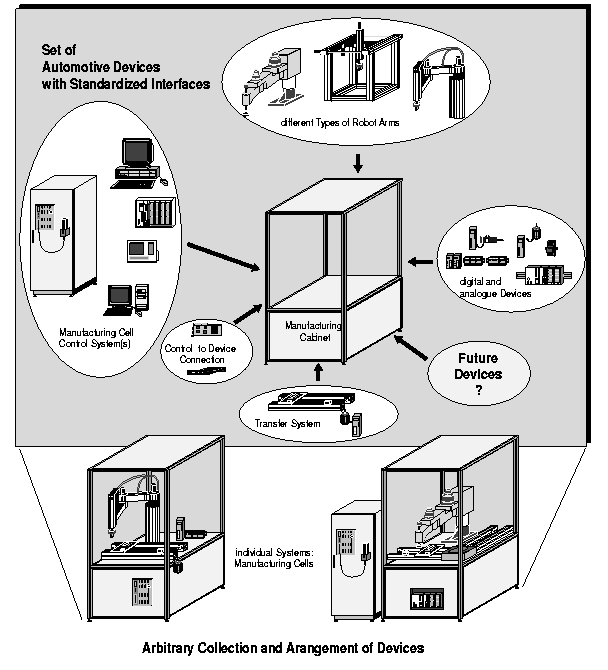
In the automation industry a model for this kind of software development processes may be found. A typical problem in automation industry is the production of highly individual production units (usually production cells) from different devices (cf. figure 1). Fortunately, most of these devices follow international standards which makes it easy to combine them. The important goals of this development are:
The production process of such individual systems has similarities to the one proposed in [Bat98, CE99b]. Therefore, such systems can benefit from generative programming. We, however, propose the use of standard components with a large number of well-defined interfaces.
On the basis of these standard components highly individual systems may be generated which can be modified and extended very easily. Moreover, a customer is able to combine these products even though they are not made with an intention to be combined and/or are from different vendors.
Summary and Outlook
In this abstract we have:
Our future work aims at investigating individual software production by combining highly independent, reusable (standard) components from different vendors.